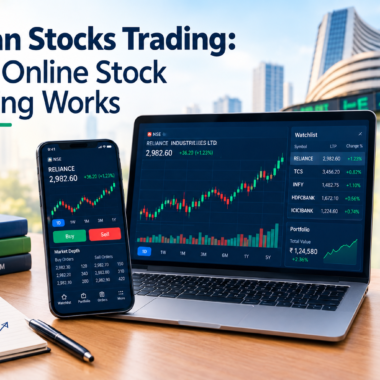
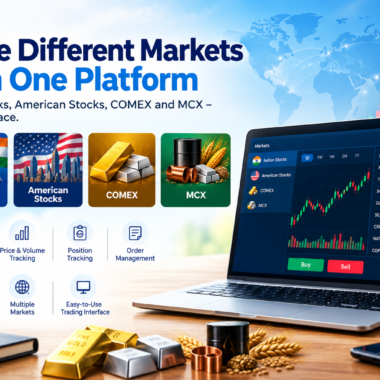
Indian stocks, domestic commodity derivatives and international commodity markets are often discussed together by active traders, but they represent different forms of market exposure. Each has its own contract structure, price drivers, trading hours and risks. Understanding these differences is especially important when a platform advertises access to several markets under one account.
Indian equity markets
Indian stocks represent shares of listed companies. Investors and traders may study company earnings, valuations, sector developments, interest rates and broader economic trends. Equity prices can move sharply after earnings announcements, regulatory decisions or changes in investor expectations.
A trader should distinguish long-term ownership from short-term speculation. The same stock can be suitable for one approach and inappropriate for another depending on the investor’s objective and risk capacity.
MCX and commodity derivatives
The Multi Commodity Exchange is a major venue associated with commodity derivatives in India. Contracts linked to commodities such as gold, silver and energy products can be used for trading or hedging.
Commodity futures have expiry dates and specific contract sizes. Margin requirements mean traders can obtain exposure without paying the entire notional value upfront, but leverage also increases the impact of adverse price changes. Contract specifications should be read before trading.
COMEX and international metals
COMEX is widely followed for global metals pricing. International gold and silver markets can influence expectations in other regions, although domestic prices may differ because of currency movements, local demand and market structure.
Anyone comparing international and Indian prices should check units, currencies, contract specifications and trading hours. A quoted number is meaningful only when the underlying contract is understood.
Market drivers
Different markets respond to different information. Equities may react to corporate results and sector news. Precious metals can respond to interest rates, inflation expectations, currency movements and risk sentiment. Energy prices may be influenced by production decisions, inventories and geopolitical developments.
Because the drivers differ, a trader should avoid assuming that one indicator will work equally well across all markets.
Technology and platform access
Modern platforms can combine multiple instruments in one dashboard. Watchlists, alerts, charts and portfolio views make it easier to follow several markets. However, the convenience of a single screen can hide important differences in contract rules.
Before using a dabba trading platform, verify what the platform actually provides and whether it has a recognized regulatory and settlement framework. Market access should not be assumed simply because a website displays a price.
Leverage and risk
Derivatives can provide high notional exposure relative to deposited capital. This is useful for hedging and capital efficiency but creates significant risk for inexperienced traders. A position that looks small in cash terms may represent a much larger underlying exposure.
Risk calculations should include contract size, tick or price value, margin requirements and potential gaps. Traders should also have a predefined maximum loss.
Diversification is not a guarantee
Holding exposure across stocks, domestic commodities and international commodities can diversify the sources of return, but markets can still move together during major global events. Correlations may change when investors become risk-averse.
Diversification works best when combined with sensible position sizing and an understanding of how each instrument behaves.
Conclusion
Indian stocks, MCX & COMEX Trading-linked products each provide a different market experience. Learning the mechanics of the instrument is essential before comparing strategies or platforms. Anyone searching for dabba trading in india should additionally verify how the service executes, records and settles transactions.
A broad market menu is useful only when the trader understands the risks behind each product.
Keyword note: Readers comparing services should research dabba trading platform carefully, verify the operator’s identity and understand how orders, records, settlement and withdrawals are handled.
Keyword note: Readers comparing services should research dabba trading in india carefully, verify the operator’s identity and understand how orders, records, settlement and withdrawals are handled.
Keyword note: Readers comparing services should research dabba trading app carefully, verify the operator’s identity and understand how orders, records, settlement and withdrawals are handled.
Keyword note: Readers comparing services should research dabba trading app carefully, verify the operator’s identity and understand how orders, records, settlement and withdrawals are handled.
Questions worth asking support
Before depositing, ask specific questions in writing: What entity operates the account? Where are orders executed? What is the settlement process? Which rules govern margin? What documents are issued after execution? How does a withdrawal work? Which formal complaint channel is available?
Clear, consistent answers are useful evidence. Evasive replies, pressure to deposit or instructions to use unrelated payment accounts should be treated as warning signs.
A prospective customer should feel comfortable asking difficult questions before transferring money.
Users should also distinguish between information and execution. A chart can be accurate while the service displaying it is unsuitable for placing a real transaction. Review every important claim independently, especially claims involving regulation, returns, leverage and withdrawals. Taking additional time at the beginning is usually easier than trying to resolve a problem after money has already been transferred.
Another useful habit is to avoid making decisions from a single data point. Price, volume, news, Margin and Account Information should be considered together. If an application encourages rapid action without giving the user enough time to understand the transaction, the convenience of the interface can become a source of avoidable risk.
Transparency is also important when a service changes its terms. Users should review notifications about fees, margin, market availability and withdrawal conditions rather than assuming that the original terms will remain unchanged. Keeping copies of important documents helps create a clear record of what was agreed at the time an account was opened.