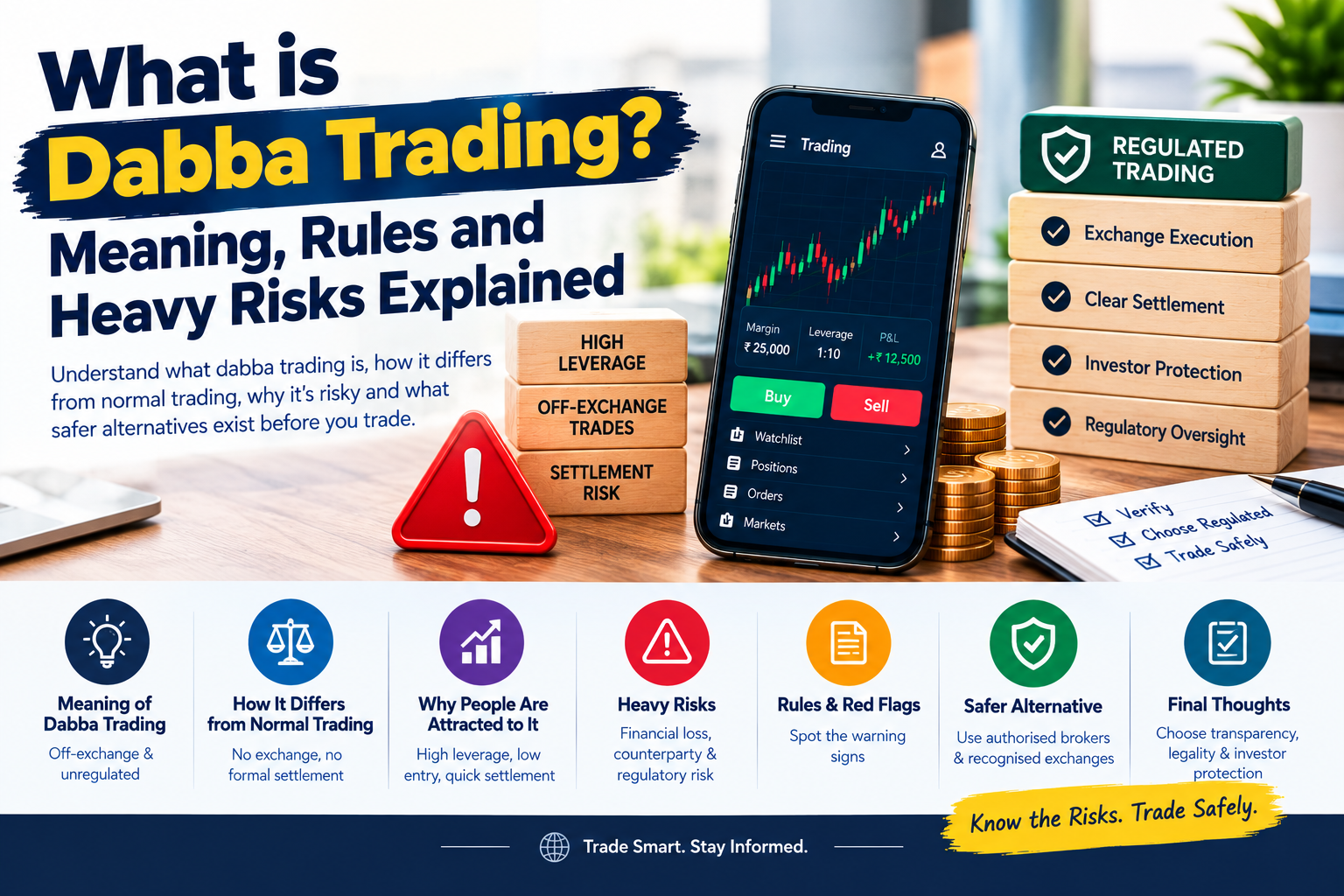
Dabba trading is a term that appears frequently in discussions about alternative trading methods in India. Some people discover it through local networks, messaging groups or online platforms that promise high leverage and easy access to market prices. Because the model can resemble normal online trading, understanding its meaning is important before making any decision.
Meaning of Dabba Trading
Dabba Trading is an off-exchange form of trading in which a customer’s transaction is not actually executed on a recognised stock exchange. Instead, an operator records the customer’s position internally and settles the resulting gain or loss with the customer.
SEBI categorises dabba trading as illegal and unregulated. The absence of an actual exchange trade is the defining feature.
How It Differs from Normal Trading and Dabba Trading
A regulated stock-market transaction passes through established infrastructure. An authorised intermediary handles the customer’s order, the exchange records the transaction and clearing and settlement occur under defined rules.
In dabba trading, the operator can act as the counterparty. The customer may see an account balance and open positions, but those records may exist only within the operator’s own system.
This difference is much more important than the appearance of the website or app.
Why People Are Attracted to It
Dabba operators may advertise low entry requirements, high leverage, simple account opening and fast settlement. These features can appeal to traders who want to control a large position with limited capital.
However, high leverage increases exposure. It does not change the direction of the market or remove the possibility of loss.
Understanding the Heavy Risks
The first major risk is financial loss. A leveraged position can lose money quickly when the market moves against the trader.
The second is counterparty risk. If the operator controls the internal record and settlement, the customer depends on that operator to honour the arrangement.
The third is regulatory risk. Since the trade is not executed through a recognised exchange, the customer does not have the normal protections associated with exchange-based transactions.
SEBI also explains that investors cannot use the stock-exchange grievance-redressal mechanism for dabba trades.
Rules and Responsible Behaviour
There is no safe version of Online Dabba Trading in India simply because an operator provides written rules or a sophisticated app. The underlying transaction remains outside the recognised exchange system.
Anyone considering a trading service should verify whether the intermediary is properly authorised and whether orders are actually executed through recognised market infrastructure.
Do not rely on verbal assurances, screenshots of profits or testimonials.
Red Flags to Recognise
Be careful with promises such as guaranteed daily profit, fixed returns, unlimited leverage, instant recovery of losses or special access unavailable through regulated brokers.
Pressure to deposit quickly is another warning sign. So is a requirement to pay a fee before withdrawing funds when that fee was not clearly disclosed at the beginning.
A professional-looking interface does not prove legitimacy.
What Is the Safer Alternative?
A trader can use an authorised broker and recognised exchange to participate in permitted securities-market activities. Before trading, understand the product, margin requirement, brokerage and other applicable charges.
Keep contract notes and transaction records. Use official channels for payments and avoid giving account credentials or OTPs to third parties.
Final Thoughts
The simplest way to understand dabba trading is this: it may copy the appearance of Market Trading without providing an actual exchange transaction.
That distinction creates serious risks involving legality, settlement, counterparty reliability and investor protection. High margin may make the offer look attractive, but it can also magnify losses.
For anyone asking “What is dabba trading?”, the most important answer is not how to join it. It is understanding why the model is considered illegal and why regulated alternatives offer a more transparent framework for participating in financial markets.
Regulatory reference: SEBI Investor guidance on Dabba Trading.